Introduction
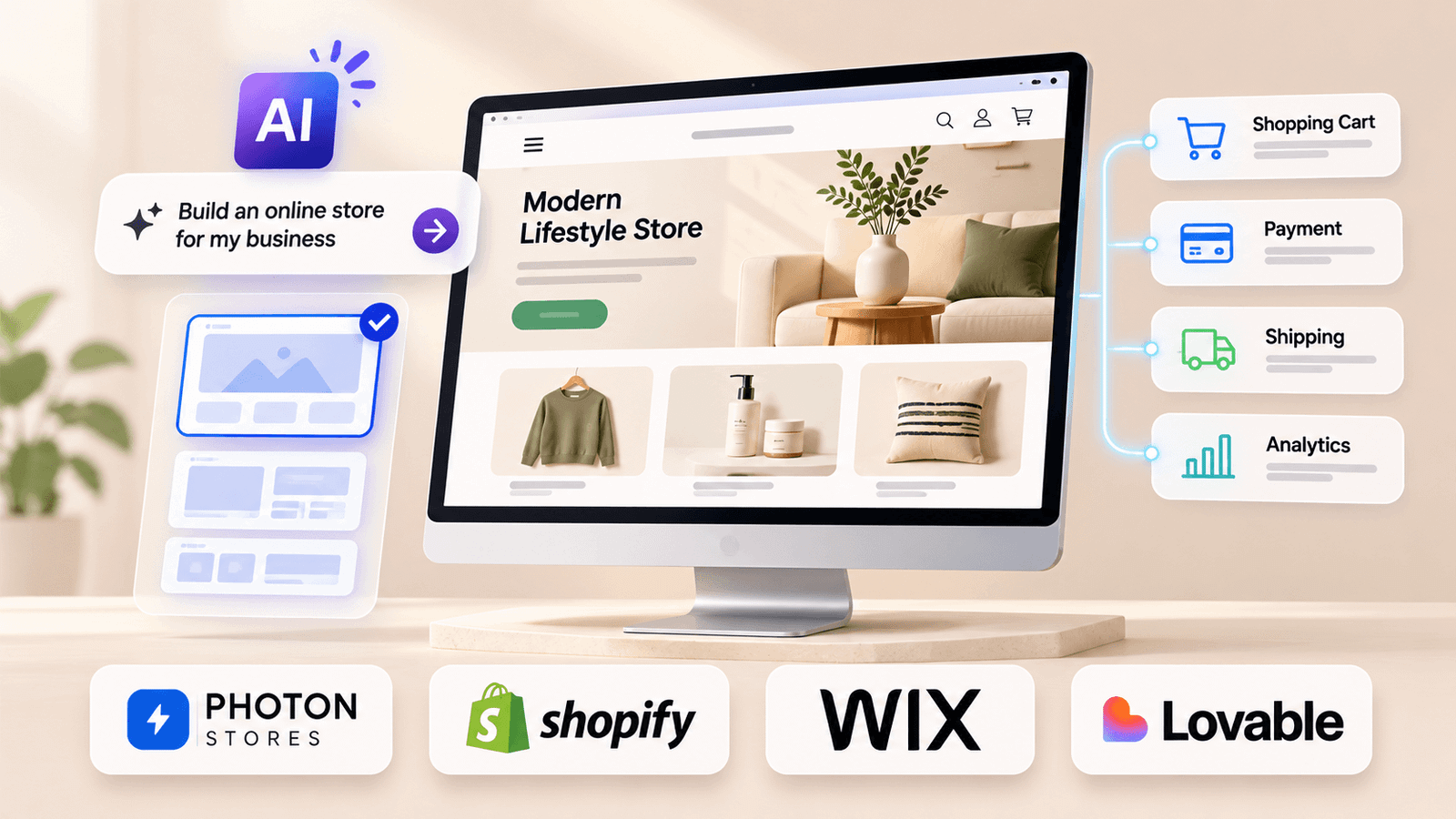
Coding hours, intricate design work, and a big development budget are no longer necessary when creating an e-commerce website. AI-powered e-commerce website builders are making it simpler than ever for companies to transform an idea into a fully operational online store in 2026.
These tools are revolutionising the way e-commerce businesses are started and run, from creating storefront designs with straightforward instructions to writing product descriptions, modifying product photos, and automating store management.
But not every AI e-commerce builder operates in the same manner. While some concentrate on creating storefront designs, others use AI-powered solutions for product management, marketing, SEO, customer service, and shop operations in addition to creating websites.
Shopify, Photon Stores, Wix and Lovable are the six top AI builders for e-commerce websites.
I’ve created a sample store on each platform to give you a better idea of what each one offers, how their AI features work in practice, how easy they are to use, and how they could suit your company’s requirements.
What Are AI E-commerce Website Builders?
AI-powered e-commerce website builders use AI to help you create and set up an online store based on a brief description of your business. You tell the AI what you sell, and it creates the shopfront for you, saving you the trouble of selecting templates, organising sections, and writing each page yourself.
Most of them can:
- Create a whole store layout that includes the navigation, product pages, and homepage.
- Compose SEO content, page copy, and product descriptions.
- Create or modify product photos
- Apply your brand’s colours, fonts, and overall design guidelines.
- Make changes when you ask in plain language, such as “make the hero smaller”
- Helps with recurring tasks including customer service, discounts, and inventory
Types of AI E-commerce Builders
- E-commerce platforms with AI added – Established e-commerce platforms that have added AI to their existing tools. Shopify is the main example.
- Website builders with AI – General website builders that now generate pages and online shopfronts from a text prompt. Wix is the example in this guide.
- AI-first builders – Newer tools built around AI from the start. Photon Stores uses a team of AI agents to design the store and help run it, and Lovable generates a custom storefront through a chat, closer to working with a developer.
This difference shapes how each one feels to use, and it is the main thing the rest of this guide compares.
How I Tested Each AI Builder
To keep the comparison fair, I tested all four platforms the same way. I gave every builder the same prompt for a premium gold jewellery store, changing only the store name. I then made follow-up edits where possible and compared each builder on:
- Brief match: How closely it followed the prompt
- Speed: How long the first build took
- Design: How the storefront looked out of the box, and whether it offered options
- AI editing: How well it followed plain-language changes
- Editing control: Manual editing, approvals and undo
- Selling tools: Products, cart, checkout and payments
- India readiness: Rupee pricing, cash on delivery and tax
- SEO: Page titles, descriptions, sitemap and redirects
- Cost: Free trial and paid plans
The prompt I used:
“Build a premium luxury jewellery e-commerce website named [store name] with an elegant design, gold jewellery product collections, a beautiful homepage, product pages, shopping cart, and checkout. Use a sophisticated ivory, gold, and beige colour palette with premium typography and luxury product photography. Make it fully responsive and modern.
1. Shopify AI Builder
Shopify is an established e-commerce platform that has added AI on top of its existing tools. You describe your store, the AI builds it, and Sidekick, Shopify’s AI assistant, helps you edit it afterwards.
Best for: Sellers who want an established e-commerce platform with AI-assisted store creation and built-in tools for managing products, payments and orders.
What it does well
- Follows the brief closely: The palette, the typography and the luxury photography all matched what I asked for
- Complete first draft: Pages, product photos, descriptions and rupee prices from a single prompt
- Two ways to edit: A visual editor for manual changes, plus Sidekick for plain-language edits
- You stay in control: Sidekick can’t change your store without your approval, and nothing goes live until you press “Publish”
- Smart product setup: It suggested a product category for each item, which helps with tax rates, filters and search
- SEO built in: Shopify automatically generates sitemaps, robots.txt and canonical tags. You can also edit title tags, meta descriptions and URL handles for individual pages, products and collections.
- Cash on delivery is possible: You set it up under Settings, Payments, using the Manual Payment Method
- AI usage limits: Shopify doesn’t use a monthly AI credit system, but features such as Sidekick and AI image generation have usage limits depending on your subscription plan.
- Easy to try: Shopify’s AI Store Builder is included with eligible plans. It offers a 3-day free trial, followed by a promotional price of ₹20/month for the first 3 months. Regular subscription charges apply afterwards.
Where it falls short
- Only one design: There were no variations to choose from. If you don’t like the result, you edit it or write a new prompt.
- No video: It created photos but no hero or product video.
- Branding slips: The editor showed my store name, but the storefront header and footer still said “My Store 2”, so I had to fix it.
- Thin product media: Each product had a single image, with room for more.
- Missing collections: Products weren’t assigned to collections automatically.
- Limited image editing: Sidekick can’t edit images within a store theme or product list.
- No automatic alt text: Shopify does not generate alt text or manage image metadata across the catalogue.
- One assistant, not a team: Sidekick handles everything, with no separate specialists for photography, video or SEO.
- India setup is on you: Shopify Payments isn’t available in India, so you need a third-party gateway, which adds fees.
My take
Shopify’s AI builder can put together a decent-looking store in just a few minutes, but the result still needs some work. While it offers better editing tools, SEO features and e-commerce functionality than most newer AI builders, its AI capabilities are still fairly limited. You get only one design option, no video generation, and will need to fix several details yourself. For sellers looking to grow their business, this might be a reasonable trade-off. But if you’re expecting AI to do most of the work for you, Shopify still requires quite a bit of manual effort.
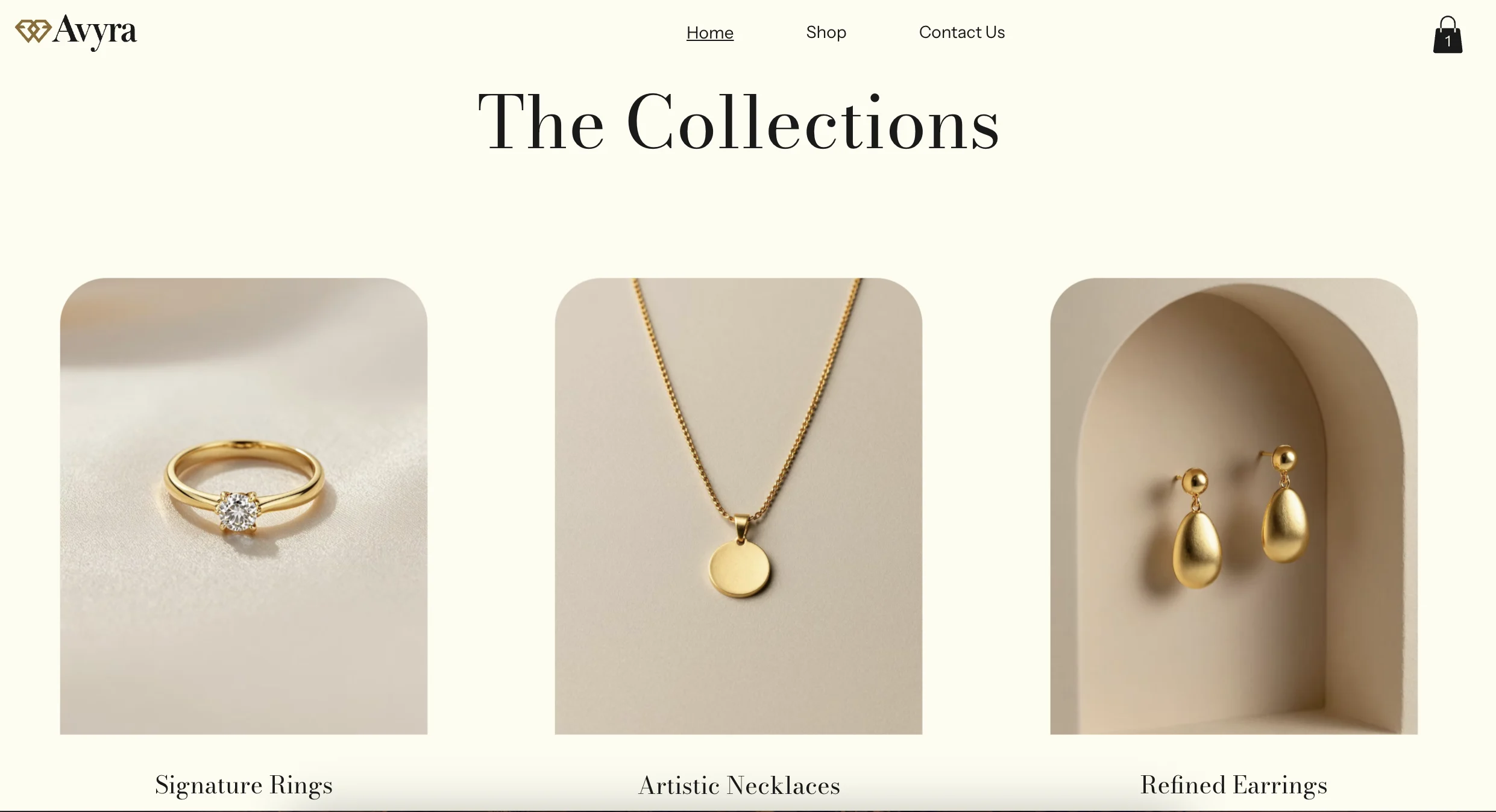
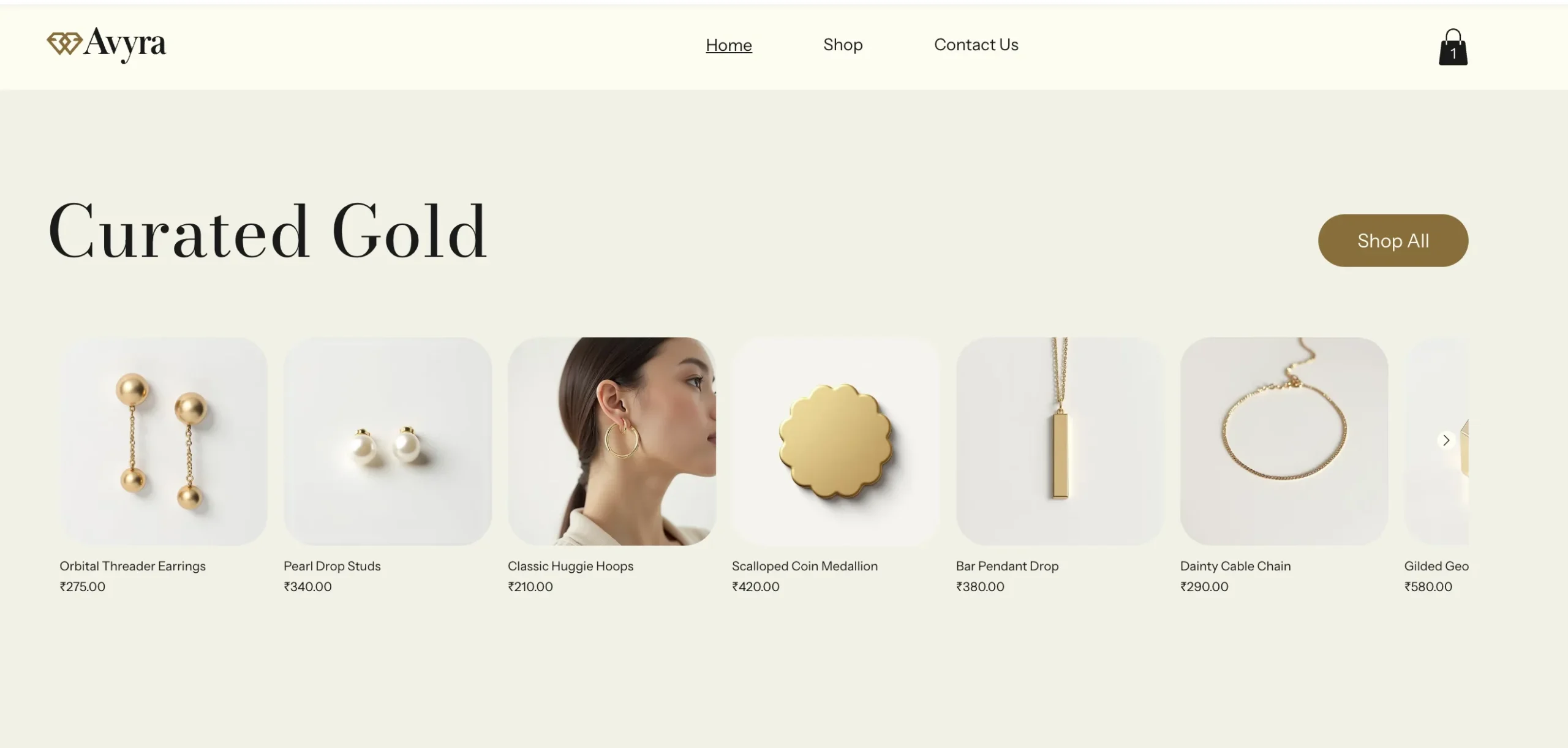
Screenshot 1: Below is the homepage generated using Shopify’s AI tool, featuring a hero image, headline, and category thumbnails.

Screenshot 2: Four collection tiles: rings, necklaces, earrings and bangles


2. Photon Stores
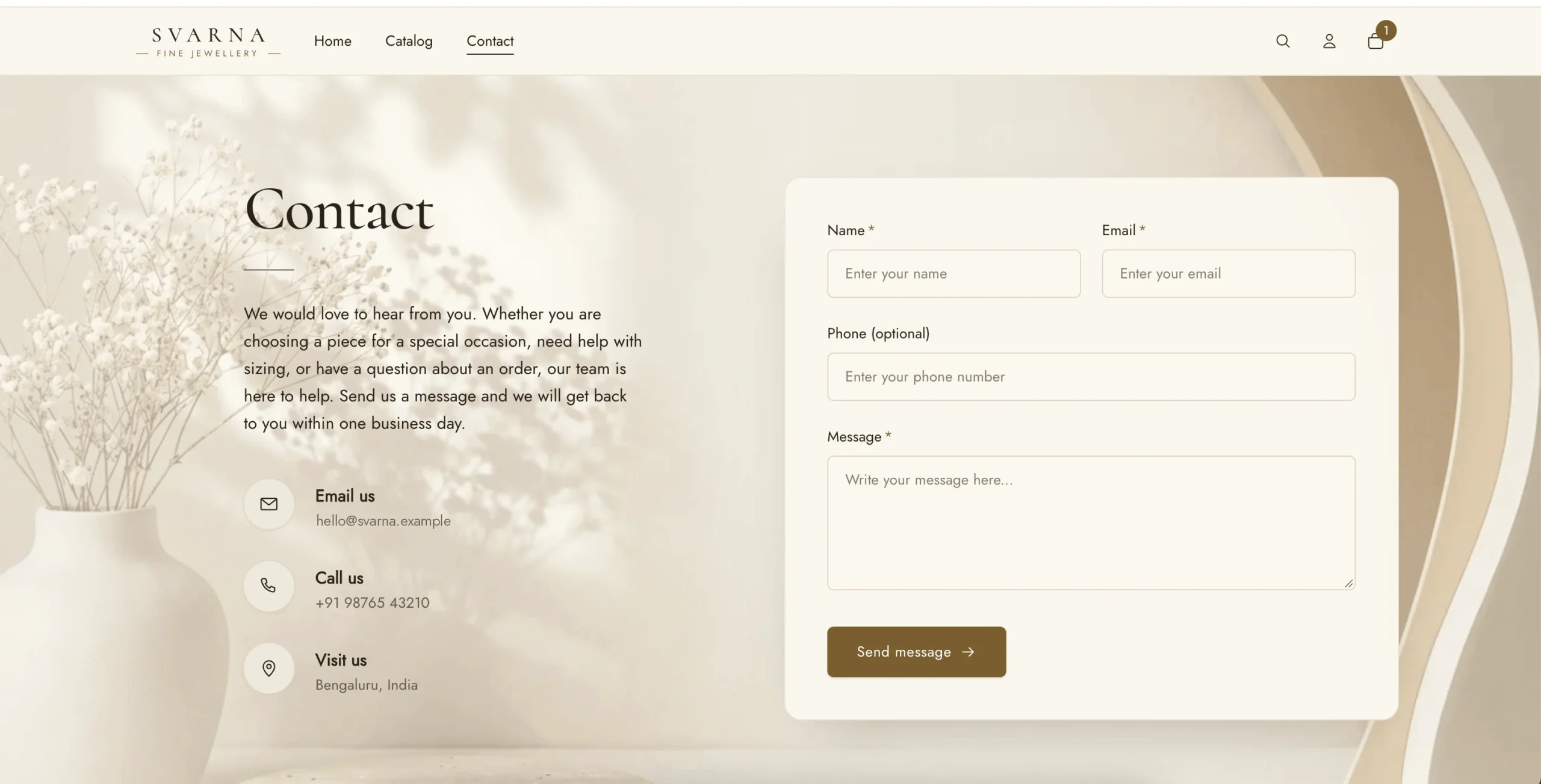
Photon Stores is built around AI from the beginning. You describe your business, choose from three generated store designs, and Photon creates the website, product content and product photography. It also includes a team of specialised AI agents to help manage and grow the store after launch.
Best for: Sellers who want AI to handle more than just website design, including product photography, SEO, content creation and day-to-day store management.
What it does well
- Three designs to choose from: Generates three different storefront designs from the same prompt, so you can choose the one you prefer.
- Complete first draft: Creates website pages, product listings, descriptions and AI-generated product photographs.
- Dedicated AI agents: Instead of relying on one assistant, Photon has specialised agents for website development (Forge), content (Quill), SEO (Ranker), photography (Lens), video (Reel), marketing (Buzz) and store operations.
- Product photography and video: Generates AI product photographs and includes a dedicated video agent for creating product videos.
- SEO built in: Generates page titles, meta descriptions, structured data, XML sitemaps, robots.txt and an llms.txt file for AI assistants.
- Built-in payment options: Supports card payments, digital wallets, bank transfers and Cash on Delivery through payment providers.
- Store management: Includes product variants, inventory tracking, orders, shipping, returns, refunds and tax invoices.
- Store migration: Allows you to import products, prices, images and other store information from Shopify and WooCommerce.
- Analytics and integrations: Provides sales and visitor analytics, with support for Google Analytics 4 and Meta Pixel.
Where it falls short
- Usage limits: Plans come with monthly AI credits. Generating more photos or making more changes uses credits.
- Paid subscription: Photon Stores offers a free trial on its paid plans, allowing users to explore the platform before subscribing. The Starter plan begins at ₹2,499/month + 18% GST.
- AI-generated content needs review: Product descriptions, photographs, SEO content and other generated elements should be checked before publishing.
My take:
Photon Stores takes a more AI-focused approach to ecommerce website creation. It offers three design options, generates product photography and provides separate AI agents for tasks such as SEO, content, video and store management. Photon Stores aims to automate more of the ecommerce workflow.
It is an interesting option for sellers who want more AI involvement beyond simply generating a website.



3. Lovable AI Website Builder
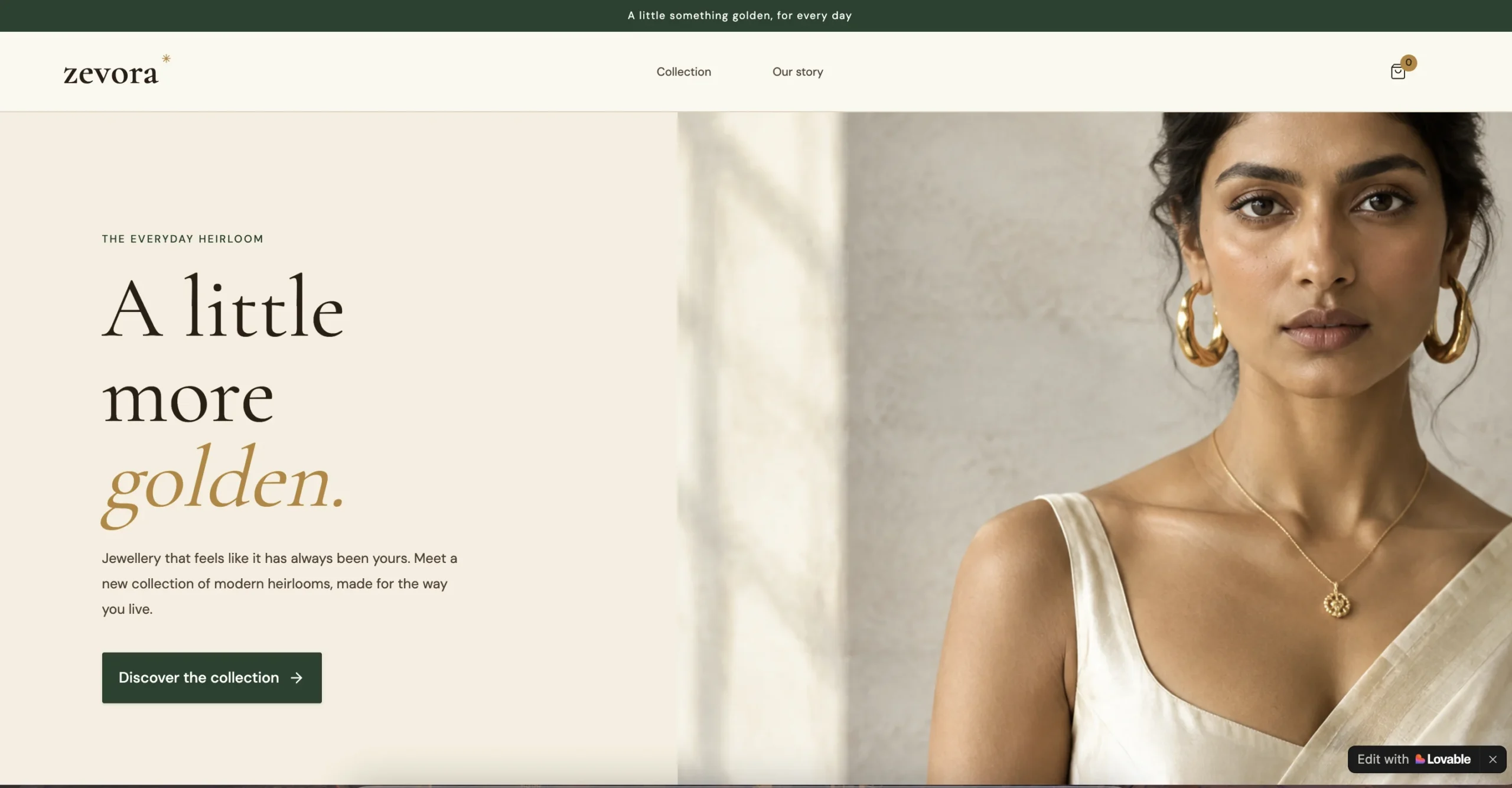
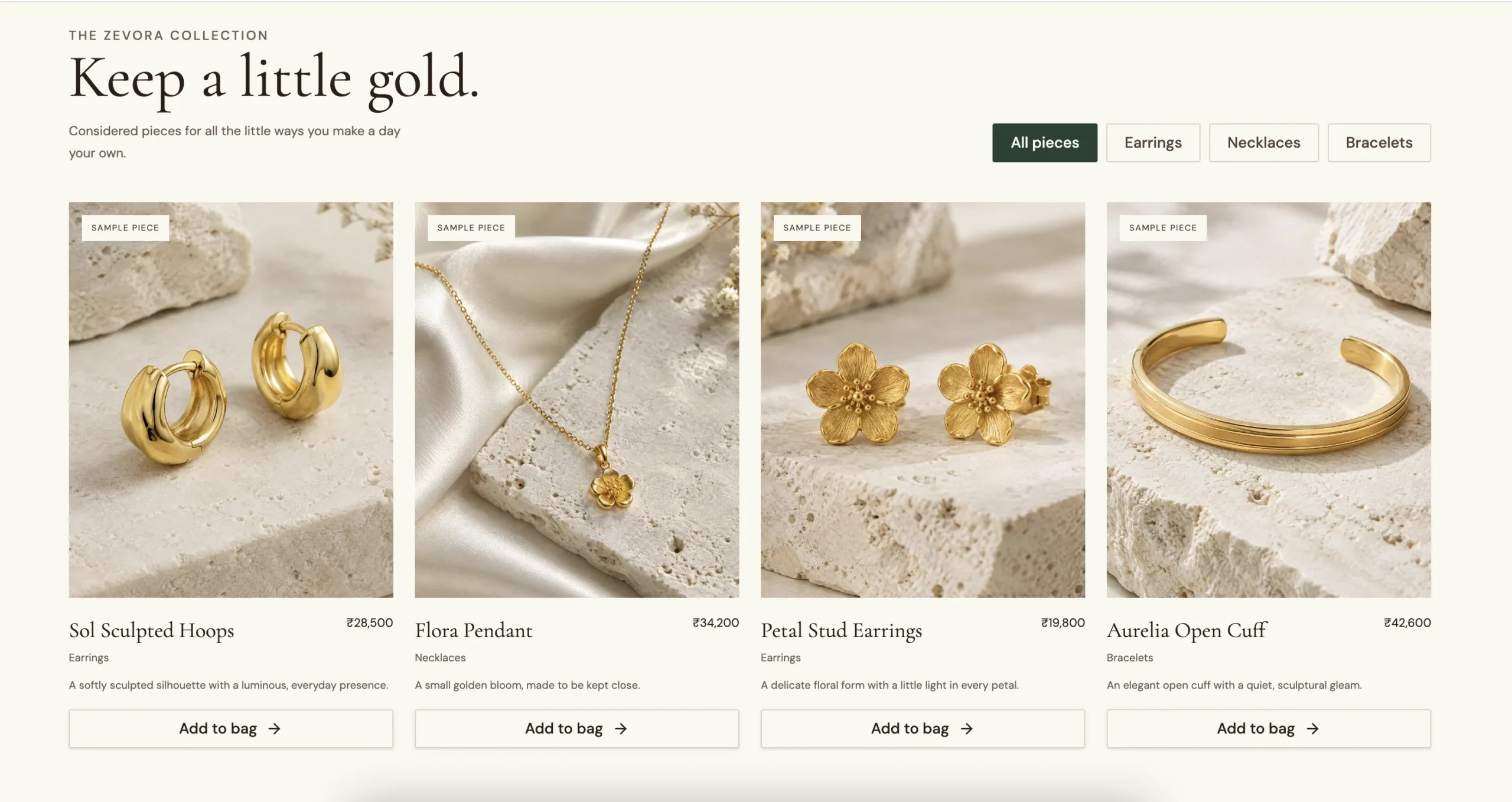
Lovable is an AI-powered website and app builder that turns text prompts into working websites. You describe what you want, and Lovable generates the design, content, pages and functionality. You can then refine the website by chatting with AI or editing the code directly.
Lovable focuses on generating custom websites and applications, with ecommerce functionality added through integrations and development.
Best for: Users who want more design flexibility and custom website functionality, and are comfortable configuring integrations and ecommerce features themselves.
What it does well
- Builds from a prompt: Generates a website with layouts, pages, sections and navigation from a written description.
- Custom designs: Creates landing pages, business websites, portfolios and online storefronts based on your requirements.
- Edit using prompts: You can change text, images, layouts and add new sections by chatting with AI.
- Code access: Unlike many traditional website builders, Lovable lets you view and edit the generated code directly.
- SEO built in: Generates clean page structures, fast-loading pages and editable metadata to help search engines understand your website.
- Hosting included: You can publish your website directly through Lovable and connect a custom domain.
- Payment integrations: Supports integrations such as Stripe to add payment functionality.
- Other integrations: You can connect tools for email, maps, forms, Google Sheets and other services.
- Ecommerce support: Its online store builder can generate storefronts, product pages and checkout experiences.
Where it falls short
- Limited free plan: Free users get limited AI credits, and published websites are invite-only rather than publicly accessible.
- AI credit limits: Each prompt and modification consumes credits depending on the complexity of the task. More usage requires a paid plan.
- Custom domain requires payment: Connecting your own domain requires a Pro plan or higher.
- Payment setup requires integration: Lovable uses Stripe for payment processing or allows you to connect an existing Shopify store. Payment provider fees are separate.
- Not a traditional ecommerce platform: Unlike Shopify, Lovable focuses on building custom websites. You need to configure the ecommerce functionality, integrations and store workflows.
- SEO still needs work: It provides editable metadata and search-friendly page structures, but keyword research, content optimisation and ongoing SEO work are still required.
- Limited free publishing: The free plan does not allow unrestricted public website publishing.
- No dedicated AI specialist team: Lovable uses its AI builder to handle design, content and functionality rather than offering separate AI agents for photography, SEO, video and marketing.

4. Wix AI Website Builder
Wix is an established website-building platform with AI tools for creating and managing websites. You describe your business and the type of store you want, and its AI generates a website with pages, images and content. You can then make changes by chatting with its AI assistant or editing the design manually.
Best for: Sellers who want an AI-generated ecommerce website with visual editing tools and built-in features for managing an online store.
What it does well
- Creates a storefront from a prompt: Generates a website based on your business, design preferences and requirements.
- Visual editing: You can move elements, change layouts, adjust fonts and colours, and edit sections using drag-and-drop tools.
- AI-assisted editing: You can ask the AI assistant to redesign pages, change content or generate new sections.
- Product descriptions: AI can generate multiple product description options based on product details.
- Product image editing: Includes AI tools to change backgrounds, improve image quality, remove unwanted objects and edit parts of an image.
- Video support: Wix provides a library of videos and tools to add video content to your website.
- Built-in ecommerce: Wix Stores supports product pages, categories, product variations, inventory, discounts, checkout and order management.
- SEO tools: AI can suggest page titles and meta descriptions. Wix also provides SEO settings to customise these for individual pages and products.
Where it falls short
- Limited design choices: The AI generates a starting design, but you need to make manual changes if you want a different look or more control over the layout.
- Ecommerce needs a paid plan: You can build a website for free, but accepting online payments requires a Core plan or higher.
- Some setup is still required: Products, prices, payment methods, shipping and other store settings need to be configured before you can start selling.
- Editor limitations: Wix has separate editing environments, and websites cannot currently be transferred between Wix Harmony and the classic Wix Editor or Wix Studio.
- Not all features are supported: Some Wix apps and elements are not yet available in Harmony.


Conclusion
All four AI builders make it easier to create an e-commerce website, but Photon Stores stood out in my testing with its multiple design options, AI-generated product photography and specialised AI agents. Shopify is ideal for scaling, Wix offers easy visual editing, and Lovable provides greater design flexibility.