
// Insights
Harness Engineering: Why Your AI Rig Matters More Than Your Model
By Keshav Sharma · Published June 29, 2026
TL;DR — A harness is the runtime layer that wraps an LLM: the agent loop, semantic router, retrieval pipeline, tools, constrained decoding, memory, guardrails, and observability. Same model, different harness, very different results. Vercel’s agent went from 80% to 100% task success after cutting 80% of its tools, with tokens halved and latency dropping from 724 seconds to 141 — model unchanged. A well-rigged 8B-parameter model now routinely beats a raw frontier model on production tasks, at a fraction of the cost. In 2026, the question is no longer “which model?” but “what harness?”
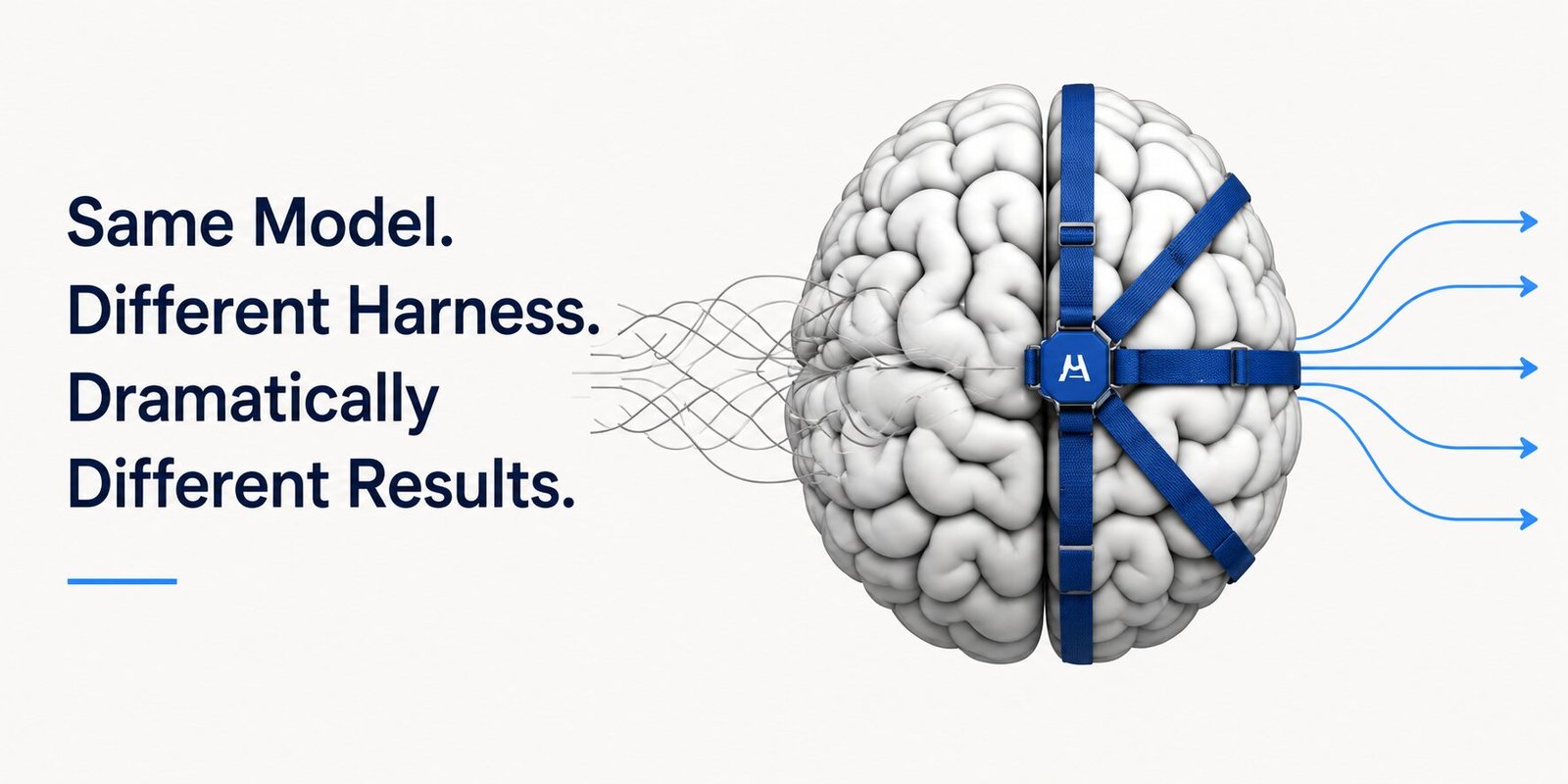
Beyond Prompting: The Era of Harness Engineering
For two years the industry obsessed over prompt engineering — coaxing better outputs out of models with cleverer instructions. As AI moved from demo to production, a harder reality landed: prompting is not engineering. No amount of “think step-by-step” will stop a model from hallucinating clauses in a contract, returning malformed JSON to a payments API, or routing a one-line greeting to a trillion-parameter model and burning $0.40 of inference cost.
Harness engineering (also called AI rigging or LLM orchestration) is the discipline that replaces prompt-as-product with system-as-product. It is now the bottleneck. Through 2025–2026, every public case study comparing same-model, different-harness setups has shown that the surrounding system matters more than the model weights.
At Simplileap, we have moved from shipping prompts to shipping harnesses. This post is a working guide to what that means technically, why a properly rigged small model can outperform a raw frontier model, and how to build a production-grade rig yourself.
What Is Harness Engineering?
Harness engineering is the practice of designing the programmatic scaffolding — agent loop, data pipelines, tool dispatch, context policies, structured outputs, memory, and observability — that surrounds a language model and turns it into a reliable, controllable system.
If the LLM is a high-horsepower engine, the harness is the entire car: chassis, transmission, brakes, steering, dashboard. A Ferrari engine on a bare frame goes nowhere. A frontier model behind a thin wrapper is a demo, not a product.
The term was popularized by Viv Trivedy and adopted by OpenAI’s Codex team in their February 2026 engineering post documenting a million-line agent-generated codebase. Anthropic’s engineering team has published parallel work on long-running agent harnesses, context engineering, and code execution with MCP. The discipline is now well-defined enough to teach, benchmark, and hire for.
Where prompt engineering is about what you tell the model, harness engineering is about how the model interacts with your systems, data, and users in a controlled, programmatic way.
Why Harness Engineering Matters Now
Three forces pushed the harness from afterthought to bottleneck.
Models are converging. Across 2025–2026 the gap between frontier models on most agentic benchmarks narrowed. GPT-5.5, Claude Sonnet 4.6, Gemini 3.1 Pro and the strongest open-weight models cluster close on real-world tasks. Differentiation has moved up the stack to the harness.
Most production deployments fail. Industry analyses estimate that roughly 88% of enterprise AI agent projects never reach production. The cause is almost never the model. It is scaffolding — agents that lose coherence, hallucinate tool calls, blow through context windows, or fail silently with no traces.
The economics flipped. A mid-tier model inside a well-designed harness now beats a frontier model behind a thin wrapper on accuracy, cost, and latency simultaneously. Switching from a top-tier API to a smaller hosted model and reinvesting the savings into retrieval, evals, and validation routinely nets out positive on both quality and cost.
In 2026, “which model do I use?” is the wrong first question. The right question is “what harness am I building around it?”
The Four Mechanisms of a Production Harness
At a working level, every production rig combines four mechanisms. These map directly to four classes of LLM failure they eliminate.
| Mechanism | Solves | Implementation |
|---|---|---|
| Semantic routing | Wasted spend on overkill models | Embedding-based intent classification routes simple queries to cheap/local models |
| Advanced retrieval (RAG) | Hallucination, stale knowledge | Hybrid search (BM25 + dense vectors) + cross-encoder reranking |
| Constrained decoding | Broken JSON, schema drift | Logit-level grammar enforcement against Pydantic / JSON Schema |
| Tool calling and agentic logic | Math errors, fake API calls, brittle multi-step work | Offloading deterministic operations to code; structured tool contracts |
Below those four mechanisms sits the deeper engineering anatomy.
The Seven Layers of a Harness
A working rig has seven engineering layers. You can collapse some in simple cases, but if any are missing entirely, you will hit a wall in production.
1. The Agent Loop
The loop calls the model, parses its output, executes tool calls, feeds the results back, and decides when to stop. Common patterns:
- ReAct — alternate reasoning and action steps. Simple, debuggable, well-tested.
- Plan-and-execute — produce a full plan first, then execute it. Good for long-horizon work; brittle when plans need revision.
- Reflexion / self-critique — the model reviews its own output and iterates. Expensive but powerful for high-stakes tasks.
- Ralph Wiggum loops — keep the agent in a tight iteration cycle, refining until a quality gate passes. Popular in Codex-style coding agents.
Stop conditions matter more than people realize. Most failed agents either stop too early (“I think I’m done”) or never stop (token death spiral). Explicit termination criteria — passing tests, reaching a doc state, exhausting a step budget — are non-negotiable.
2. Context Management
Context is finite, expensive, and scarce. The harness decides what the model sees on every call.
Anthropic’s engineering team frames this as the natural successor to prompt engineering: context engineering is the discipline of curating which tokens land in the model’s window across the lifecycle of a task. Components the harness juggles: system prompt, task description, retrieved documents, tool definitions, conversation history, intermediate scratchpads, long-term memory.
The hard part is compaction. When the window fills, what gets dropped, what gets summarized, what gets persisted? A bad compaction policy is the single most common reason agents lose coherence on long tasks. OpenAI’s Codex team replaced a monolithic 1,000-line AGENTS.md with a 100-line table of contents pointing to structured docs — progressive disclosure beat upfront dumping, and quality measurably improved.
3. Tool Surface
Every tool definition consumes context. Every tool the model could plausibly call is a branch in its decision tree. More tools means more reasoning load, more wrong selections, more malformed arguments.
Vercel’s documented case: they cut 80% of their agent’s tools. Success climbed from 80% to 100%. Tokens dropped by more than half. Latency fell from 724 seconds to 141 — same model.
Practical rules: start with the smallest tool set that works; prefer one high-level tool over five low-level ones; make schemas self-describing; return parseable errors the agent can recover from.
4. Memory
Short-term memory lives in the context window. Long-term memory needs a separate store — vector DB, key-value store, knowledge graph, or hybrid.
The 2026 consensus is async memory writes — writes that block the response pipeline add perceptible latency. Graph-augmented systems like Mem0g now reach 66–68% on multi-hop retrieval benchmarks, making memory tractable engineering rather than open research.
Four useful memory types: working memory (current task state), episodic memory (past sessions), semantic memory (learned facts and entities), and procedural memory (skills and workflows, often encoded as reusable tools).
5. Guardrails and Safety
The harness enforces what the model is not allowed to do: input validation before tool calls, output validation (schema, content filters, PII redaction), rate and step budgets, permission boundaries for destructive actions, prompt-injection defenses for user- and web-supplied content.
The principle: never trust the model to enforce its own constraints. The harness enforces. The model only proposes.
6. State and Session Persistence
Long-running agents work in discrete sessions. Anthropic’s documented harness uses two prompts: an initializer agent (runs only on the first session — sets up environment, feature list, progress tracker) and a worker agent (runs every subsequent session — reads tracker, makes incremental progress, updates tracker, hands off cleanly). The progress file plus git history is what makes multi-day work possible.
Any agent that runs longer than one context window needs an explicit handoff artifact the next session can read in seconds.
7. Observability and Evaluation
Logs, traces, evals — the bit most teams skip until something breaks badly.
What to instrument: every model call (tokens, latency, cost, model version), every tool call (arguments, return, latency, failure mode), every loop iteration (reasoning, action, outcome), and final outcomes against agreed criteria.
Evals are not optional. The minimum useful eval is 20–50 representative tasks with deterministic pass/fail, re-run on every harness change. Most teams grow this to a few hundred cases organized by failure mode.
The David vs Goliath Effect: How a Rig Supercharges Small Models
There is a persistent myth that bigger parameters equal better reasoning. In production, a properly harnessed 8B-parameter model routinely outperforms a raw trillion-parameter model. Three mechanical reasons.
1. Cognitive Offloading
Large models burn parameters storing facts and approximating math. They are still inherently probabilistic and unreliable at arithmetic, symbolic logic, and precise lookups.
A rig does not ask the model to do math. When a user asks “calculate Q3 marketing ROI,” the harness intercepts, generates a Python expression, executes it in a sandbox, and passes the deterministic result back to a small model for explanation. The 8B model does not need to remember formulas. It only has to read the output and write a sentence.
Anthropic’s recent work on code execution with MCP generalizes this pattern: for many agentic problems the right abstraction is not “many tools” but “one tool that runs code.” The agent writes a script that composes lower-level operations. Token cost drops, composability rises, and the agent accumulates a reusable skill library over time.
2. Grounding via Advanced Retrieval
A frontier model hallucinates when it does not know an answer. A small model inside a strong RAG harness does not need to know — it synthesizes from retrieved context.
The 2026 baseline is hybrid search plus cross-encoder reranking: dense vector search (for semantic match) combined with BM25 sparse keyword search (for exact matches on names, IDs, acronyms), merged with Reciprocal Rank Fusion, then reranked by a cross-encoder that deeply compares the top 20 candidates to the query. Naive vector-only RAG is no longer state of the art.
When the small model gets only 5 rigorously verified documents instead of 20 mediocre ones, hallucination rates collapse. Its parameter count stops mattering — it is now a synthesis engine over a curated context window.
3. Constrained Decoding
Small models struggle to output clean JSON. They add stray prose, drop keys, break syntax.
Constrained decoding intercepts the model’s logits at generation time. If the next token would violate the JSON schema (or any context-free grammar), its probability is set to zero, mathematically forcing the model down a valid path. Libraries like Instructor, Outlines, and modern provider SDKs implement this directly.
The practical effect: an 8B model becomes highly reliable for downstream API integration — comfortably above the failure rate of a raw frontier-model API call relying on prompt instructions alone.
The Receipts
The smaller-model thesis is not a vibes claim. The published data is consistent.
| Scenario | Model | Result |
|---|---|---|
| Vercel agent, original harness | Same model | 80% success, 724s latency |
| Vercel agent, redesigned harness (80% fewer tools) | Same model | 100% success, 141s latency, half the tokens |
| LangChain coding agent, Terminal Bench 2.0, original | Same model | 52.8% |
| LangChain coding agent, Terminal Bench 2.0, redesigned harness | Same model | 66.5% (bottom of leaderboard to top 5) |
| Princeton CORE-Bench, baseline scaffold | Same model | 42% |
| Princeton CORE-Bench, optimized scaffold | Same model | 78% |
| Harvey legal agents, harness optimization alone | Same model | More than 2× accuracy |
Each is a single-variable comparison. Only the harness changed. The deltas are large enough that “just upgrade the model” is rarely the right answer to a quality problem. Fix the harness first, then a model upgrade gives you a step change rather than a marginal one.
How to Build Your Own AI Harness: A Technical Blueprint
A working playbook, in the order you should actually do it.
Step 1: Pin One Task and Write the Evals First
Do not build a general-purpose agent. Pick one workflow your team or users run manually today. Write down what “done” looks like in a mechanically checkable form — a test passes, JSON matches a schema, a database row appears with the right fields.
Then write 20–50 evaluation cases. Inputs, expected outputs, pass/fail. Frozen. This is your regression suite, and it gets re-run on every harness change. If you cannot define success, you cannot build a harness for it.
Step 2: Implement a Semantic Router
Never send every request to your most expensive model. Use a lightweight embedding model to classify intent and route accordingly.
from semantic_router import Route
from semantic_router.layer import RouteLayer
from semantic_router.encoders import HuggingFaceEncoder

# 1. Define routes by example utterances
faq_route = Route(
    name="faq",
    utterances=[
        "What are your business hours?",
        "How do I reset my password?",
        "Where are you located?",
    ],
)

complex_reasoning_route = Route(
    name="complex_reasoning",
    utterances=[
        "Analyze the discrepancies in the Q3 financial report",
        "Draft a contract clause based on these terms",
        "Write a Python script to scrape this site",
    ],
)

# 2. Use a fast local encoder — no API cost on the router
encoder = HuggingFaceEncoder(name="sentence-transformers/all-MiniLM-L6-v2")

# 3. Build the routing layer
rl = RouteLayer(encoder=encoder, routes=[faq_route, complex_reasoning_route])

# 4. Route the query
selected = rl("How do I install the SDK?").name

if selected == "faq":
    # Cheap path: 8B model or a deterministic answer from a KB
    ...
elif selected == "complex_reasoning":
    # Expensive path: frontier model
    ...
else:
    # Fallback — ask for clarification or send to a default model
    ...
In our internal deployments and the published case data, this single change is usually responsible for 50–80% of total cost reduction in a typical agent stack. Most queries do not need a frontier model.
Step 3: Build an Advanced Retrieval Rig
Naive vector RAG is no longer the bar. A production rig uses hybrid search plus a cross-encoder reranker.
from langchain.retrievers import EnsembleRetriever
from langchain_community.retrievers import BM25Retriever
from langchain_community.vectorstores import Qdrant
from langchain_cohere import CohereRerank
from langchain.retrievers.contextual_compression import ContextualCompressionRetriever

# 1. Sparse keyword search — catches exact matches on names, IDs, acronyms
bm25_retriever = BM25Retriever.from_documents(documents)
bm25_retriever.k = 10

# 2. Dense vector search — catches semantic match
vector_retriever = Qdrant.from_existing_collection(
    collection_name="docs",
    url="http://localhost:6333",
).as_retriever(search_kwargs={"k": 10})

# 3. Hybrid: Reciprocal Rank Fusion across both result lists
ensemble_retriever = EnsembleRetriever(
    retrievers=[bm25_retriever, vector_retriever],
    weights=[0.5, 0.5],
)

# 4. Cross-encoder reranking — deep relevance scoring on the top candidates
compressor = CohereRerank(top_n=5, model="rerank-english-v3.0")

retriever = ContextualCompressionRetriever(
    base_compressor=compressor,
    base_retriever=ensemble_retriever,
)

# 5. Feed 5 high-precision documents to the synthesizer model
context_docs = retriever.invoke("How does SSO integration work?")
The architecture in one line: retrieve 20 from hybrid, rerank to top 5, hand to the model. By feeding the synthesizer model only rigorously verified context, you prevent dilution. The small model performs well because the rig did the hard work.
Step 4: Force Structured Outputs with Constrained Decoding
If the harness needs to call an API, the model must output schema-correct JSON. Do not rely on prompt instructions for this. Use constrained decoding.
import instructor
from pydantic import BaseModel, Field
from openai import OpenAI

# 1. Strict schema as the contract
class UserExtraction(BaseModel):
    name: str
    age: int
    role: str = Field(description="The user's job title")

# 2. Patch the client — enables logit-level constraints
client = instructor.from_openai(OpenAI())

# 3. Even a small / cheap model now returns schema-valid output reliably
user_data = client.chat.completions.create(
    model="gpt-4o-mini",          # or a hosted Llama-3-8B, Mistral, etc.
    response_model=UserExtraction,
    messages=[
        {"role": "user", "content":
         "John Doe is 34 and works as a Senior DevOps Engineer."}
    ],
)

print(user_data.name)  # John Doe
print(user_data.age)   # 34
Instructor, Outlines, and modern provider SDKs all implement this. The model’s logits are constrained at decode time so invalid tokens cannot be selected. JSON drift becomes a non-issue, which lets you confidently use smaller models for extraction, classification, and API orchestration.
Step 5: Wire In Tool Calling and Agentic Logic
For anything beyond synthesis — math, lookups, API calls, code execution — offload to deterministic code. The model proposes the call. The harness executes it. The result feeds back into context.
Design rules for tools:
- Short, specific names (
read_invoice_by_id, notget_data). - One-sentence descriptions the model reads at inference time.
- Strict argument schemas (the same Pydantic / Zod schemas that backstop your APIs).
- Typed returns and parseable, structured error messages.
- Idempotency where possible — agents retry; tools should tolerate that.
For complex agentic work, consider letting the model write code instead of calling individual tools. A code-execution tool composes inside a single call what would otherwise be ten back-and-forth tool invocations.
Step 6: Add Observability Before You Add Features
Trace every model call and tool call. Log tokens, latency, cost, model version, failure mode. Build the dashboard before you build the second feature.
LangSmith, Langfuse, Weights & Biases Weave, or a structured-logging pipeline into your existing observability stack all work. The non-negotiable is that you can answer “what did the agent do on case 47, and why did it fail?” within a minute.
Step 7: Iterate Against the Eval Set
Every harness change re-runs the evals. Track scores over time. The first version will be wrong. The fifth will be usable. The twentieth will be production-grade.
A Working Example: The Enterprise Support Rig
This is the architectural pattern we deploy for B2B SaaS clients who arrive with a single-model setup that has become expensive and unreliable.
The starting state. A frontier model fielding every customer query. Per-query costs in the cents, latency 4–5 seconds, occasional hallucinated features that do not exist in the product. Support team losing trust in the AI.
The harness solution, layered in:
- Semantic router — embeddings-based intent classification. A majority of queries (billing dates, password resets, basic how-tos) route to a deterministic FAQ system or a small hosted model. Only complex technical questions hit a larger model.
- Hybrid retrieval rig — BM25 + dense vectors over product docs and historical Zendesk tickets, fused with RRF, reranked by a cross-encoder.
- Small-model synthesizer — a Llama-3-8B-class hosted model reads the top 5 reranked docs and writes the answer.
- Validation layer — the harness checks that every answer cites a retrieved document. If it does not, the loop re-runs with an explicit “cite sources” instruction. If it still fails, the system escalates to a human agent rather than guessing.
- Observability — every step logged. Per-query cost, latency, retrieval recall, escalation rate tracked on a dashboard the support lead reads daily.
The pattern of results we see: order-of-magnitude reductions in per-query cost, latencies typically cut to under a fifth, hallucinations dropping to near-zero on grounded queries because the synthesizer is constrained by retrieved context. Numbers vary by client and corpus quality — measure your own.
The point is not the specific percentages. The point is the architecture: by composing routing, retrieval, constrained synthesis, and validation, a small model handles the vast majority of the workload while the frontier model is reserved for the genuinely hard tail.
Common Failure Modes
Tool bloat. Agent calls wrong tools, takes too many steps, burns tokens. Fix: cut aggressively. More than 10 tools is usually too many.
Context bloat. Agent forgets what it is doing, drifts on long tasks. Fix: compaction policy, progressive disclosure, structured external memory.
Implicit knowledge. Agent contradicts undocumented team conventions. Fix: encode conventions in repository artifacts the agent reads. If it is not in context, it does not exist.
No stop condition. Agent runs forever or stops too early. Fix: explicit termination criteria, step budgets, completion checks.
No eval loop. Every change feels like a coin flip; regressions go unnoticed. Fix: build the eval set first, run it on every change, never ship a regression.
Single-shot ambition. Trying to one-shot complex tasks. Fix: decompose. Multiple specialized agents or iterations almost always beat one giant prompt.
Skipping the handoff. Long-running tasks lose progress between sessions. Fix: explicit handoff artifact, written on every state change, read at the start of every new session.
Where Harness Engineering Goes from Here
Two patterns emerging through late 2026.
Code execution as the universal tool. Rather than exposing many discrete tools, expose one tool that runs code. The agent composes lower-level operations inside a single call. Tokens drop, composability rises, and the agent builds a reusable skill library over time.
Harness-the-harness. As harnesses grow more complex, meta-agents whose job is to design, test, and refine the inner harness are starting to appear. Evaluation harnesses for evaluation harnesses. Early but converging fast.
As frontier models keep improving, the space of useful harness designs does not shrink — it shifts. Failure modes that needed scaffolding six months ago disappear; new failure modes at the higher-capability frontier appear and need new scaffolding. The bet that harness engineering is a stable, learnable, hireable skill for the next several years looks safe.
Conclusion: Stop Upgrading Your Model. Upgrade Your Rig.
The era of throwing massive prompts at massive models is winding down. The future of production AI belongs to lean, orchestrated, meticulously engineered harnesses where the model is one component among many.
Adopt harness engineering and you cut inference cost by an order of magnitude, near-eliminate the hallucination class of bugs, and empower small, privacy-preserving models to do the heavy lifting once reserved for trillion-parameter APIs. You shift from prompter to AI systems engineer.
Working with Simplileap on AI Systems
We build agent harnesses for clients across fintech, crypto infrastructure, and SaaS — production systems for retrieval, agentic workflows, document automation, and API orchestration. If you are evaluating an agent project, struggling with one that is not making it to production, or trying to decide whether to upgrade your model or fix your scaffolding, that is the conversation we have most weeks. Talk to us about AI engineering →
Frequently Asked Questions
What is the difference between prompt engineering and harness engineering?
Prompt engineering is about crafting the natural-language input to a single model call. Harness engineering is about the programmatic system around the model — semantic routing, retrieval, constrained decoding, tool calling, memory, and observability — that turns a model into a reliable, scalable component of a real product. Anthropic uses “context engineering” as a bridge concept: the discipline of curating which tokens reach the model across the lifecycle of a task.
Can a small language model really outperform GPT-4 or Claude Opus?
Yes, on the specific class of grounded, well-defined enterprise tasks. Inside a strong harness — hybrid retrieval, cross-encoder reranking, constrained decoding, tool offload — a small model (Llama-3-8B class) routinely beats a raw frontier model on accuracy, cost, and latency together. Published comparisons from Vercel, LangChain, Princeton’s CORE-Bench, and Harvey all show 20–40 percentage point swings from harness changes on the same model. The harness handles logic and retrieval; the small model only has to synthesize.
What is constrained decoding?
A technique that intercepts the LLM’s token generation and restricts it to outputs matching a formal grammar — typically a JSON Schema or Pydantic model. Libraries like Instructor and Outlines (and most modern provider SDKs) implement this by setting invalid tokens’ probabilities to zero at decode time. The result is highly reliable structured output, even from small models.
What is the difference between a harness and a framework like LangChain or LlamaIndex?
A framework is a library of building blocks. A harness is the specific assembly of those blocks plus your own code that wraps a model for a particular task. You can build a harness with or without a framework. Most production harnesses combine framework code at the bottom with substantial custom code on top.
What are the core components of an AI harness?
Seven engineering layers: the agent loop, context management, tool surface, memory, guardrails, state and session persistence, and observability with evals. Above those, four user-facing mechanisms: semantic routing, advanced retrieval, constrained decoding, and tool calling. A production rig needs all of them, though their complexity varies with the task.
Why do most enterprise AI agent projects fail in production?
Industry analyses through 2025 estimated roughly 88% of enterprise agent projects never reach production. The cause is almost never the model. It is scaffolding — agents losing coherence on long tasks, hallucinated tool calls, context-window overflow, or silent failure with no observability to diagnose it.
What tools are used to build an AI rig?
A typical Python stack: semantic-router for routing; Qdrant, Pinecone, or Weaviate for vector storage; BM25 (via Elasticsearch, OpenSearch, or in-process) for sparse search; Cohere or a hosted cross-encoder for reranking; Instructor or Outlines for constrained decoding; LangChain, LlamaIndex, or custom code for orchestration; LangSmith, Langfuse, or Weave for observability. Pick the smallest stack that solves your task, then expand.
Is this a real engineering discipline or marketing language?
Real. The term is now used by OpenAI’s Codex team in production engineering posts, by Anthropic across their engineering blog series, and by published papers at NeurIPS, ICLR, and ICML. There are arXiv surveys cataloging the patterns. The benchmarks are public, the practitioners are hireable, and the production deployments are documented.

Author
Keshav Sharma
Co-Founder, Engineering and Lead Architect
Keshav brings over 10 years of experience in software engineering, full-stack development, blockchain technologies, and cloud-native solutions. With expertise spanning Next.js, Node.js, Smart Contracts, and Secure digital asset platforms, he has successfully delivered scalable products across industries.
LinkedIn profile →Ready to scope your next initiative?
Share your goals with our Bangalore team. We respond within one business day with a clear path from discovery to delivery.